


A New View from Saint Louis Hotel
I first set foot in Luis Eduardo Magalhaes 25 years ago, a fledgling reporter for DTN, chasing a lead on Brazil’s next agricultural frontier. Word had spread of cheap land in the Bahia Cerrado — $200 an acre for virgin soil — and it had attracted an unlikely band of young farmers from Iowa and Illinois, lured by the promise of tropical prosperity.
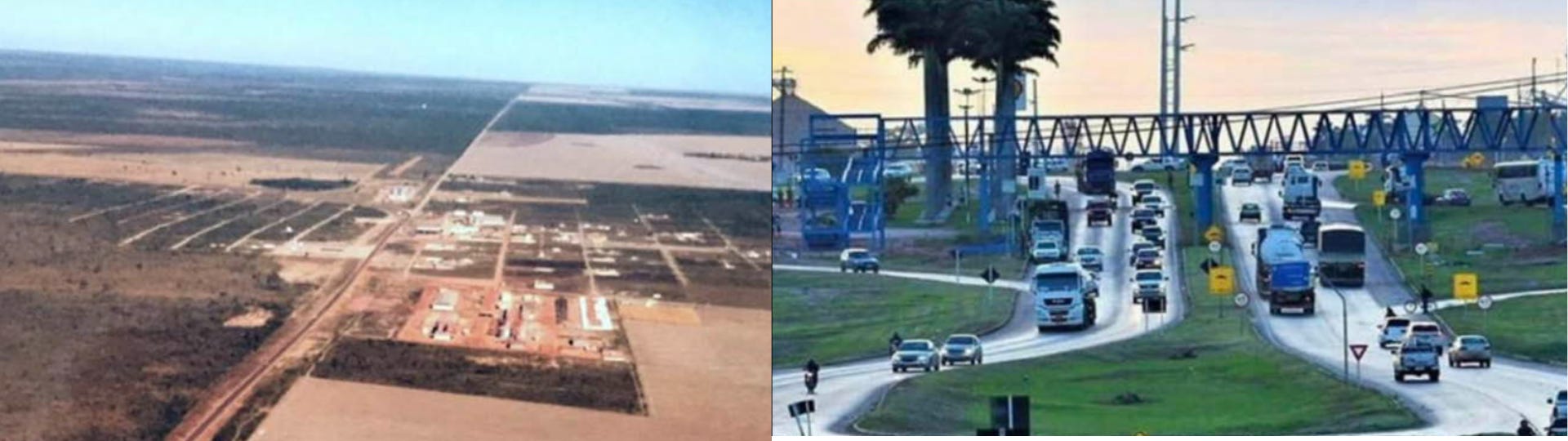
But the reality was a far cry from their Midwestern dreams. The “bargain” quickly revealed itself as a dusty bowl of hardship — a landscape more reminiscent of the 1800s Wild West than any modern farming hub. Infrastructure was non-existent, land titles were shaky, the soil was sandy and acidic, and credit was almost impossible to acquire.
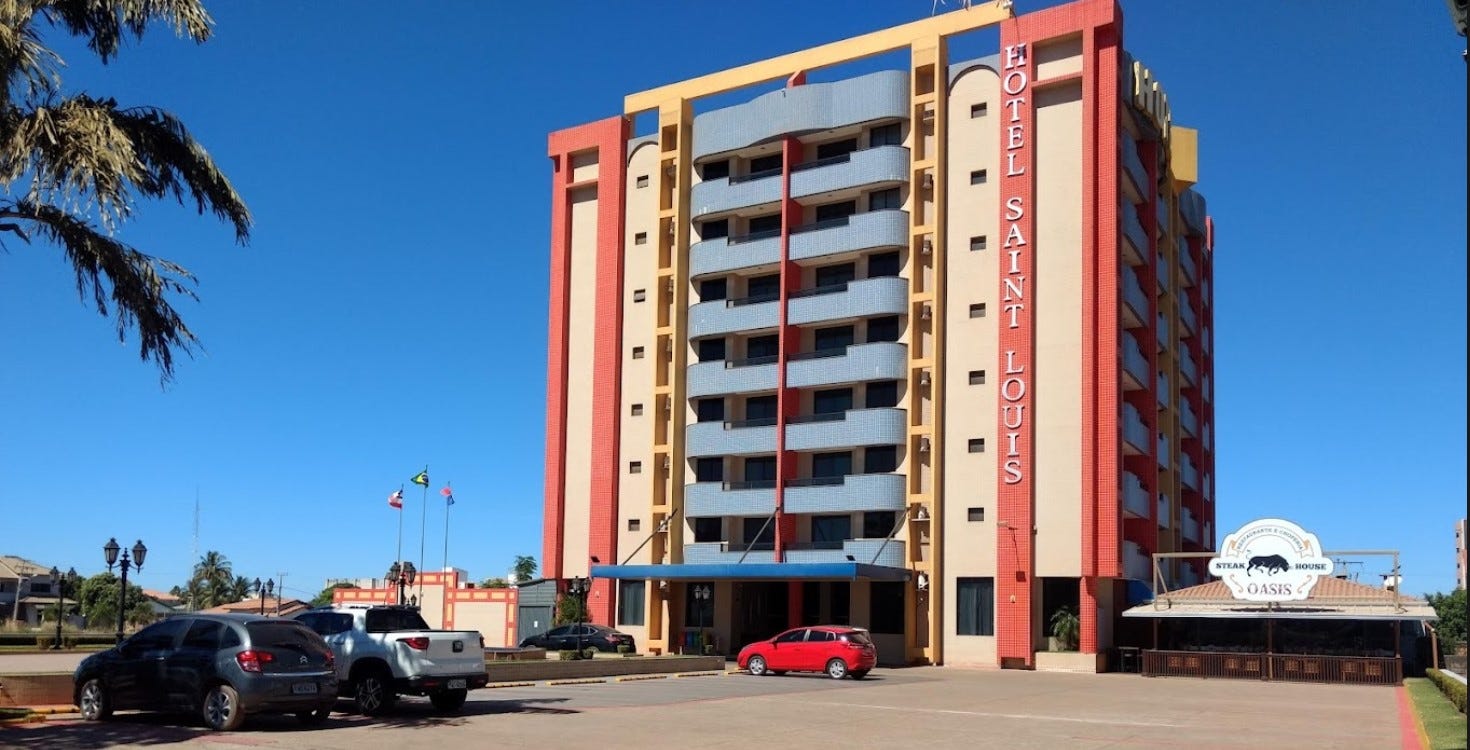
Fast forward to today, and I find myself back at the same iconic Saint Louis Hotel. But this time, the town is transformed. Luis Eduardo Magalhaes, or LEM, is no longer a gamble — it has become a hub for regenerative agriculture in the heart of Brazil’s Cerrado, or savannah region. A handful of those trailblazers from the U.S. Midwest, like Carroll Farms, endured. Their survival came not from size or speed, but from resilience, long-term thinking, and relentless innovation.
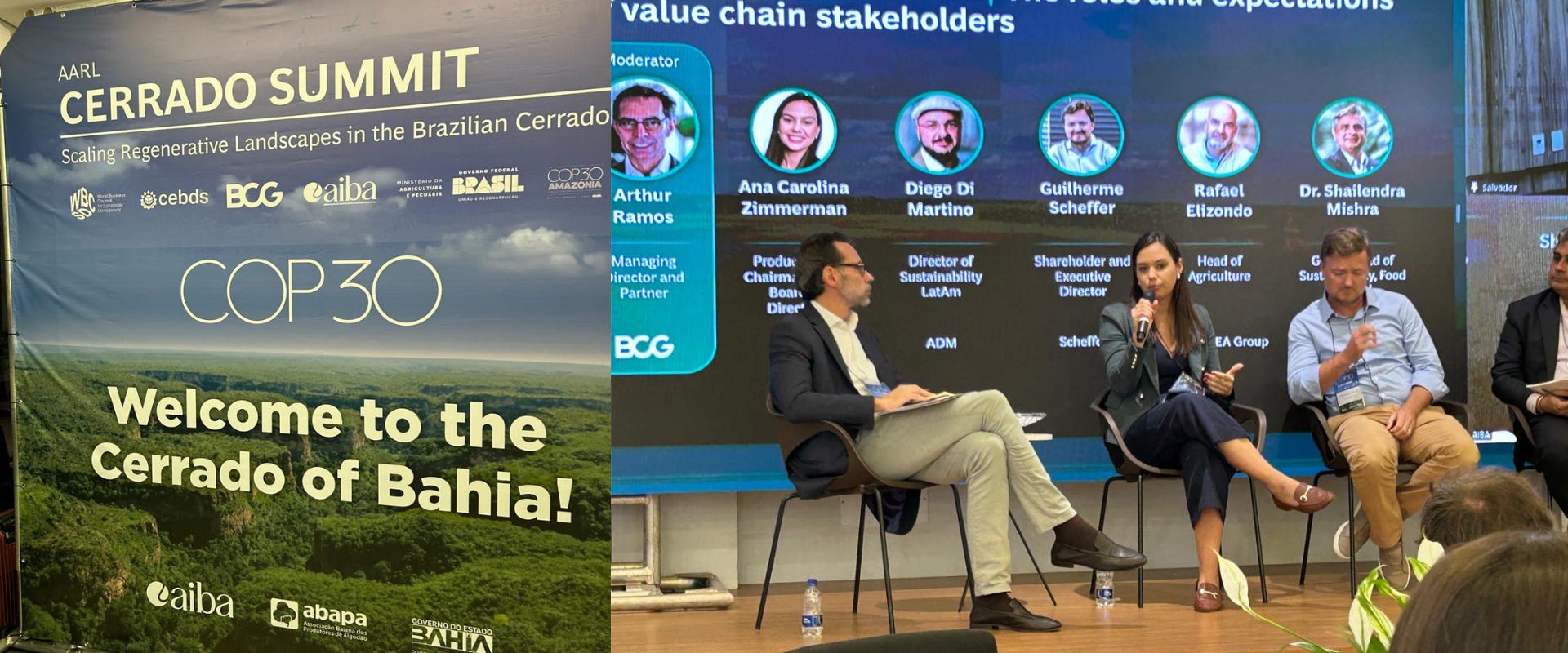
I’m no longer a reporter, but now part of a broader coalition including investors, farmers, traders, consultants, institutions, and global food companies — all gathered in this remote farm town for the Cerrado Pre-COP Summit. We’ve come to explore how this once-scrappy frontier has grown into a living model for regenerative agriculture. Not just in Brazil, but for tropical agriculture everywhere.
From Frontier to Flagship
What was once a landscape of dust and risk is now one of roots and resilience. The Cerrado has evolved — not just into a grains powerhouse, but into a living blueprint for regenerative agriculture in the tropics.
Take Fazenda Triunfo, owned by Eduardo Manjabosco, whose family began farming here in 1989. Today, his operation spans 16,780 hectares, with 6,000 hectares double-cropped, 1,600 hectares irrigated, and a plan to reach 25% irrigation by 2030. The farm has practiced no-till since 1996, implemented crop rotation and integrated crop-cattle systems since 2009, and is preparing to add swine or poultry to close the nutrient loop and produce organic manure.
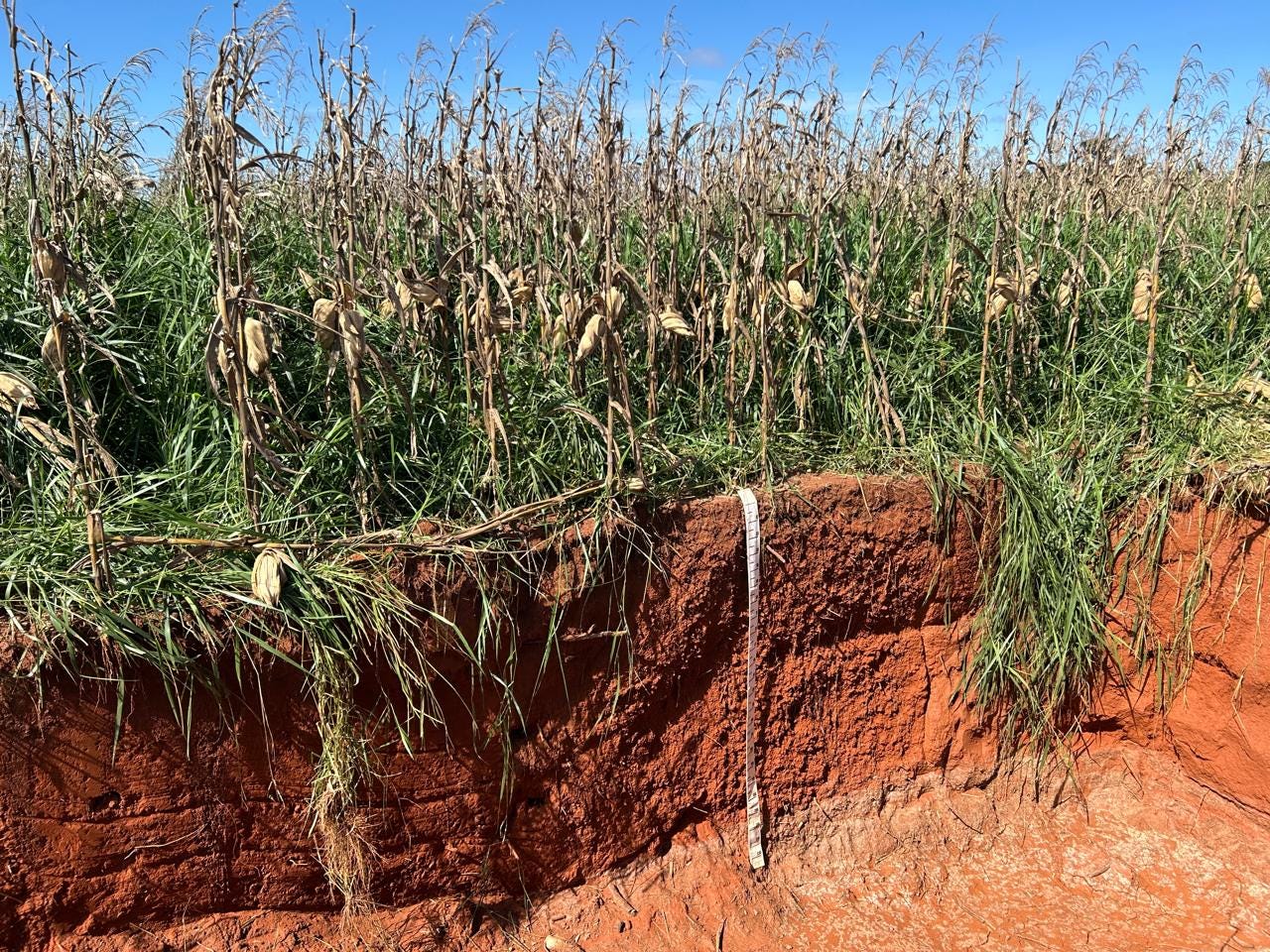
Unlike neighboring Mato Grosso, Bahia’s shorter rainy season makes traditional double cropping — like soy followed by corn — risky without irrigation. So Eduardo turned to livestock. After harvesting soy, he plants millet and pasture as a cover crop and introduces cattle — a system known locally as safrinha de boi (second crop beef). With a bit of supplemental feed, this model often outperforms soybeans economically, generating returns of over $2,000 per hectare — all while building soil health.
“We’re not sure how, as there’s no scientific explanation yet,” Eduardo says, “but for three seasons in a row, we’ve confirmed that grazing the area after harvest resulted in an extra six sacks of soybeans per hectare the following year.”
Fazenda Triunfo is now 100% solar-powered, with 78,000 tons of on-farm grain storage and 6,153 hectares of native reserve. The team also operates an on-farm biologicals production unit, which has already replaced around 50% of their chemical inputs. Recent data shows the farm's carbon footprint is 88% lower than Brazil’s national average, and the goal is to become carbon positive in the near future, through biologicals, deep-rooted crops, and circular nutrient flows.
“This is not about carbon credits,” Eduardo told us. “It’s about producing healthier soils that increase yields and drought resistance. We want to show that it’s possible — and if we can do it, anyone can. We don’t inherit the land from our parents; we borrow it from our children.”
Across the Cerrado:
Over 85% of soybeans are now grown using no-till systems.
Farmers have voluntarily preserved over 4.5 million hectares, far beyond the 20% legal requirement.
Integrated crop, livestock, and forestry systems (ILPF) now span more than 17 million hectares nationwide.
“You have to be creative and willing to take risks to survive here,” says David Weihs, partner at Carroll Farms, one of the pioneering U.S. families still farming in the region. “While most farmers wait for the first rains to start planting, we often begin 20 to 30 days earlier — guided by weather models. Sure, it backfires about 5% of the time. But the rest? It pays off. The locals still call us ‘gringo loco’ for it.”
This isn’t a return to nature — it’s a redesign of agriculture. Powered by biology, guided by data, and rooted in the resilience of local farmers like Eduardo and the Carroll family.
Thinking Global, Acting Local
The transformation of the Cerrado isn't just happening in the fields — it’s now being mapped, measured, and scaled through multi-stakeholder collaboration.
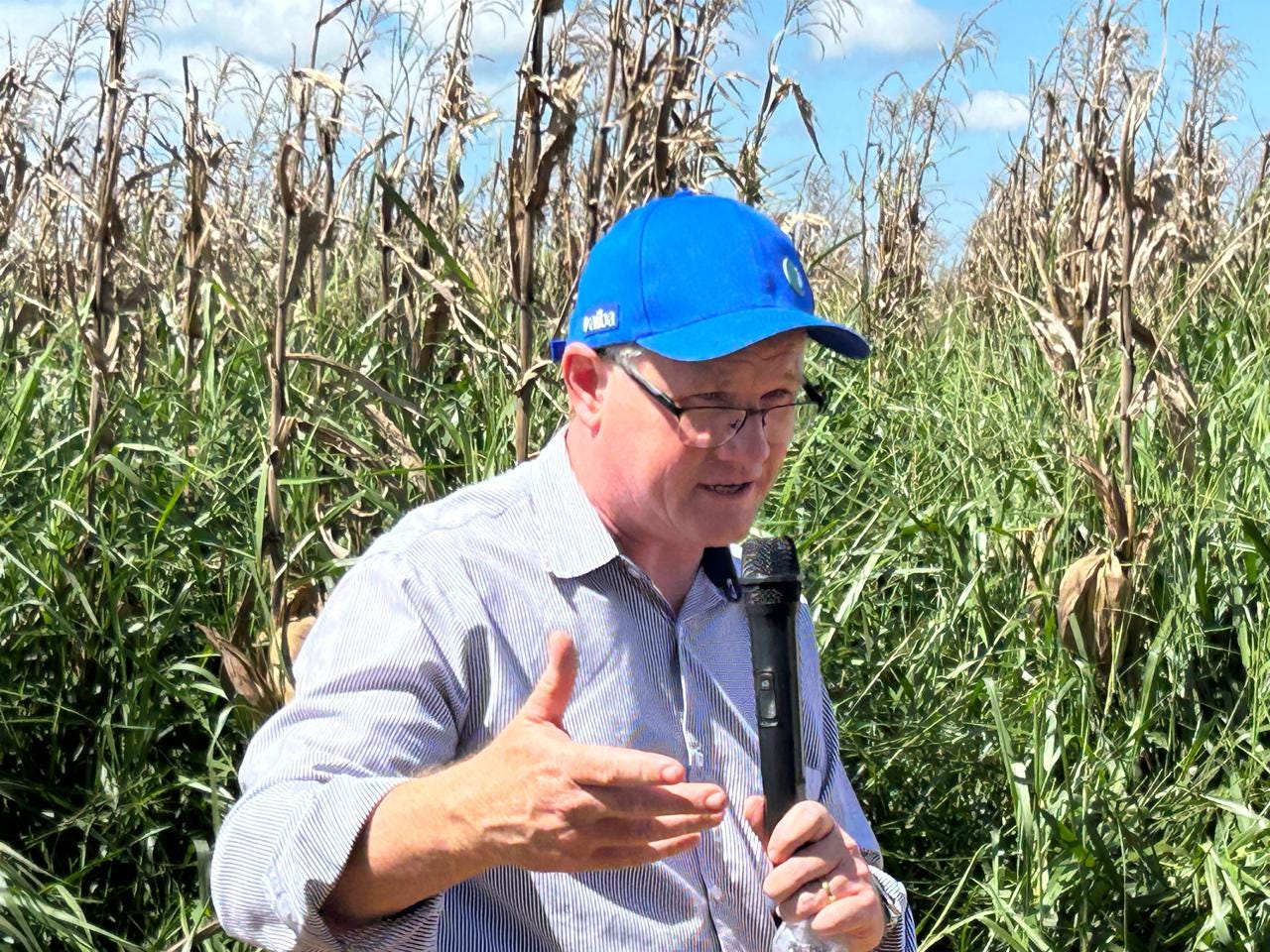
Luis Eduardo Magalhaes is host to the Cerrado Pre-COP Summit, a milestone event bringing together an unlikely but necessary coalition: farmers, agribusinesses, startups, CPGs, banks, NGOs, and policymakers — all focused on building a regenerative transition for one of the world’s most important agricultural regions.
The room was filled with voices that don’t usually share the same table:
Farmers like Guilherme Schefer and Ana Carolina Zimmerman, who would like to see more financial incentives and recognition for farmers who have already begun their regenerative journey.
CPGs like Danone, Nestlé, and PepsiCo, seeking to decarbonize their supply chains while supporting supplier resilience.
Banks and financial institutions including Rabobank and the IFC, tasked with deploying capital into systems that reduce risk over time, not amplify it.
NGOs and ecosystem builders like The Nature Conservancy, WBCSD, CEBDS, and Aiba who are helping to define metrics and mechanisms that can unlock billions in aligned capital.
One participant put it simply: “The Cerrado isn’t a problem to solve — it’s a solution to scale.”
But what stood out wasn’t just the data — it was the sense of shared urgency and opportunity. Everyone in the room seemed to agree: scaling regeneration in the Cerrado isn't a branding exercise. It's a strategy for the long-term competitiveness and resilience of farmers everywhere.
From Blame Game to Business Case
Finance, Incentives & De-Risking Regeneration
For years, finance was the elephant in the regenerative room. Farmers blamed banks for high interest rates. Banks blamed farmers for lack of track record or data. CPGs hesitated to pay premiums without guarantees. And policymakers waited for someone else to move first.
That stalemate is finally breaking.
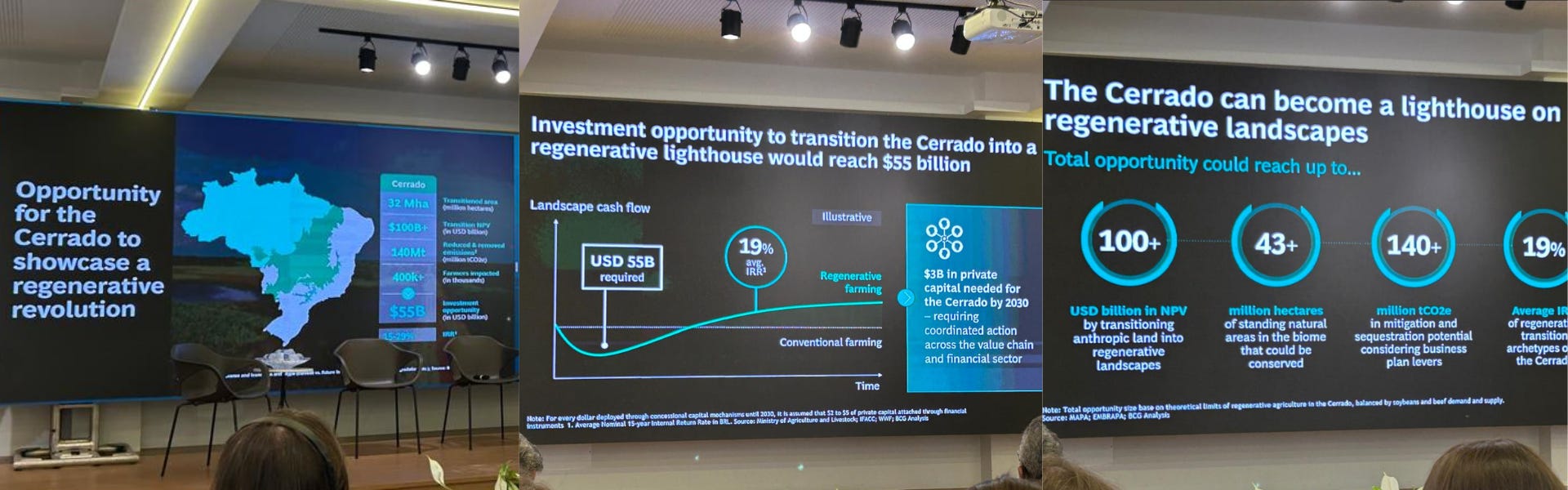
At the Cerrado Summit, finance wasn’t a side conversation — it was center stage. BCG laid out a robust economic model showing how blended finance could unlock $3 billion in private capital to convert 32.3 million hectares of Cerrado to regenerative agriculture, with an estimated average IRR of 19% and a reduction of 140 MtCO₂e over the next 15 years.
But more than capital, the conversation focused on confidence.
As one speaker put it: “We don’t lack capital. We lack pipelines of investable, verifiable projects with predictable outcomes.”
That’s where the new Landscape Accelerator for Brazil (LAB) comes in — a program being developed by this collaborative group to accelerate the transformation of key landscapes through three pillars:
Finance – activates the transition
MMRV – enables the transition
Policy – underpins the transition
There’s also a recognition that public-private-philanthropic partnerships (4Ps) will be key.
As one participant from the private sector noted: “This isn’t about ideology anymore — it’s about business. If we want farmers to transition, the economics must work — and it will take all of us pulling in the same direction to make that happen.”
Some of that is already happening. IFC linked $8 billion in ag lending to sustainability targets last year alone. And corporate buyers are starting to think in terms of multi-year contracts tied not just to volume and quality, but also to soil carbon, water use, and biodiversity metrics.
If we want the Cerrado to scale regeneration, it won’t happen through goodwill or guilt. It’ll happen through smart design — and a business case that speaks the language of both the land and the ledger.
A Blueprint for the Tropics
What’s unfolding in the Cerrado is more than a regional evolution — it’s a prototype for the tropics.
This isn’t just Brazil’s story. It’s a playbook for dozens of countries across Latin America, Africa, and Southeast Asia where agricultural expansion has collided with ecological limits. The Cerrado shows that it’s possible to feed the world, restore the land, and build viable businesses — all at the same time.
The ingredients are clear:
Farmers who think long-term and manage complex systems.
Technologies that measure what matters.
Financial tools that reward resilience and sustainabilty.
And a coalition of actors who understand that collaboration beats compliance.
We still have work to do. But for the first time in a long time, there’s a sense that the incentives, the data, and the capital are beginning to align. What started as a dusty frontier may soon shape the global conversation about how to regenerate agriculture at scale.
As the world looks toward COP30 in Belem later this year, the Cerrado offers more than metrics. It offers momentum. A chance to show that tropical agriculture — often seen as part of the climate problem — can lead the way toward a solution.
And for me, sitting again at the Saint Louis Hotel 25 years after that first visit, the view has never been clearer.
Thanks for reading and feel free to leave your comments below!
KFG 🚀
Kieran Finbar Gartlan is an Irish native with over 30 years experience living and working in Brazil. He is Managing Partner at The Yield Lab Latam, a leading venture capital firm investing in Agrifood and Climate Tech startups in Latin America. All views, opinions, and commentary expressed are strictly his own.