


Great ideas only scale when timing, access, and market drivers all line up in the same direction.
Right Time
Timing is the least glamorous part of a startup story, yet it’s often the most decisive factor — and the most overlooked. Teams work obsessively on technology. Investors make big bets on talent. But the market has its own clock, and it rarely tells you what time it is.
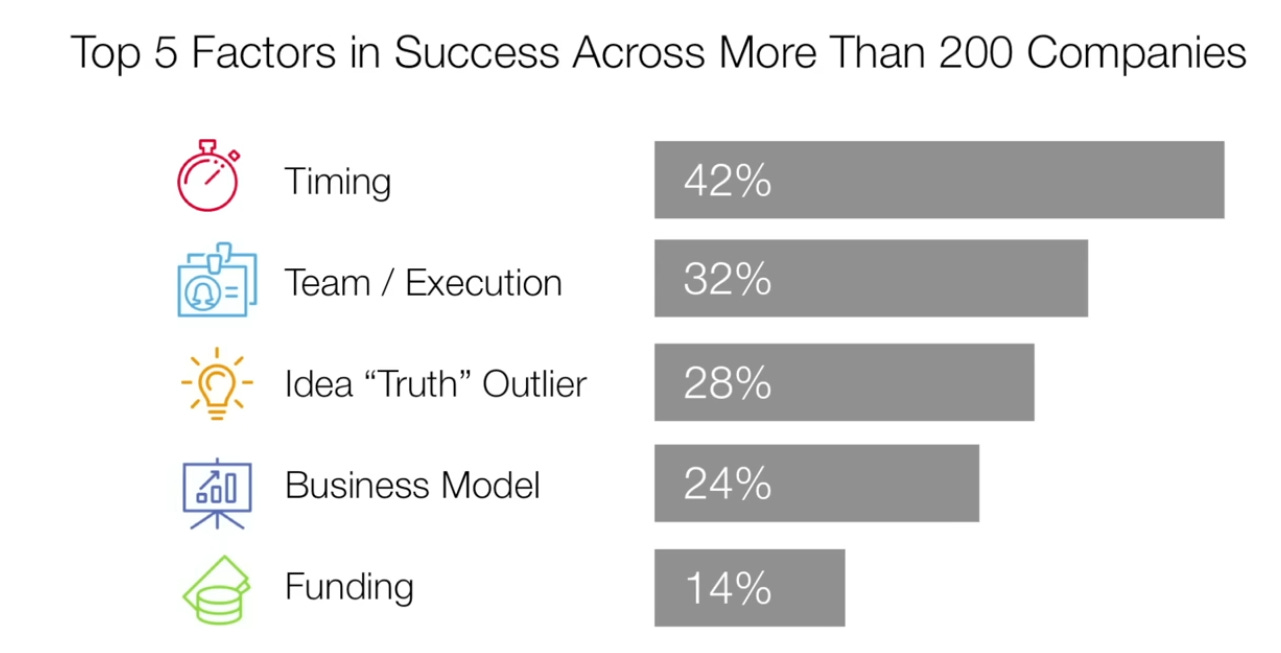
Bill Gross, the founder of Idealab, discovered this the hard way after launching dozens of startups across different industries. Some thrived. Many didn’t. Eventually he ran a study comparing factors across a few hundred companies — team, idea, funding, business model, and timing. Timing dominated them all. A good idea at the wrong moment failed just like a bad one.
That doesn’t mean execution doesn’t matter. It just means markets open and close on their own schedule. Some founders hit the window perfectly. Others build brilliant products in years the market simply isn’t ready.
Technologies that look obvious in hindsight often spent years gathering dust because the ecosystem wasn’t there yet. Others explode almost overnight because a pressure point, a trigger, or a shift suddenly opens the door.
Every founder wants to build the future. The real test is whether the future shows up while they’re still in the driver’s seat.
Early Bird
Some companies don’t miss the future — they meet it too early. Kodak is the textbook case. Long before we carried cameras in our pockets, a young engineer inside the company built the first digital camera prototype in 1975. The technology worked. It was clunky, slow, and expensive, but it worked. The problem was that the world had no use for it yet. Retail photo labs, printers, storage, sensors — none of it existed at consumer scale. Kodak had the right idea, just delivered into a market that wasn’t remotely ready.
When a company gets burned by being early, it often becomes blind to the moment when the world finally catches up. Kodak fell into that trap. As digital imaging became viable decades later, they hesitated. They had already been bitten and didn’t want to bet the company again.
QR codes followed a similar arc, though with a luckier ending. Created in 1994 to track parts in Japanese factories, they spent years bouncing around marketing teams, always clever but never critical. People saw them, but no one needed them. Then COVID forced restaurants to eliminate physical menus, and a quiet, underused square suddenly found its purpose. The technology didn’t improve; the context did. Timing finally clicked.

Blind Spot
Even when founders build something genuinely useful, they often misread who actually cares enough to pay for it. It’s one of the most common and costly blind spots in early-stage companies: assuming the user is the customer, or assuming the person with the problem is the same person with the budget.
Our Argentine portfolio company, Kilimo, learned this lesson early on. Their platform helped farmers irrigate more efficiently, save water, and improve decision-making. Farmers liked the insights. Agronomists appreciated the data. But the urgency wasn’t there. Water savings were valuable in principle, yet not painful enough in practice to trigger rapid adoption or meaningful spending.
Meanwhile, a very different group was feeling real pressure: corporate sustainability teams. Auditors, investors, and global buyers were demanding verified water data, risk assessments, and credible reduction claims. These companies weren’t looking for agronomic improvement; they were looking to satisfy compliance requirements and avoid reputational headaches. Kilimo didn’t change its technology — it changed its angle. The same water insights became the foundation for a verified water-offset program, sold to buyers upstream rather than farmers downstream.

Market Watch
Sometimes markets don’t evolve gradually — they snap open when a single enabling force arrives. That force can be technological, like GPS, which quietly transformed what was possible long before anyone realized it. Before accurate positioning lived inside every phone, ideas like real-time navigation, ride-hailing, food delivery, or on-demand logistics were simply unbuildable. The concepts weren’t new; the infrastructure wasn’t there. Once GPS became universal and reliable, an entire generation of companies suddenly had a runway.
E-signatures existed long before 2000, but adoption stayed stuck because they weren’t legally recognized. The moment the U.S. ESIGN Act and the EU’s eIDAS rules came into force, digital signing went from fringe to mainstream. This single regulatory shift unlocked the rise of DocuSign, Adobe Sign, and a wave of workflow platforms that had been waiting patiently in the wings. A market that had been stagnant for a decade transformed almost overnight because the law finally caught up with the technology.
In both cases, timing wasn’t about founder brilliance. It was about sensing when the environment had finally tipped in favor of new behavior. One new technology or one new regulation can redraw the map overnight, opening an opportunity that didn’t exist the day before. Founders who spot these changes early are the ones who get to build while everyone else is still adjusting.

Mind the Chasm
Getting market timing right is hard because most of the forces that shape it sit outside our control. You can build something smart and still arrive years before anyone cares. When that happens, you either wait or shift your focus until the world catches up — but in both cases you need to watch the signals carefully: where pressure is rising, where incentives are shifting, and where the system is starting to open.
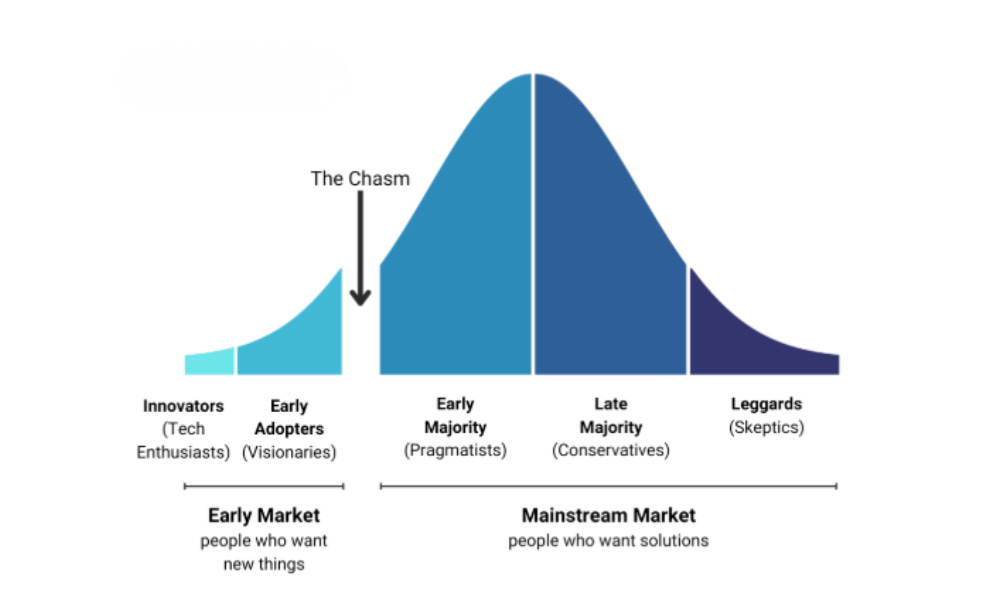
If product–market fit isn’t clicking, widen the search. The most obvious user isn’t always the one who feels the pain or holds the budget. Geoffrey Moore talked about the chasm between early adopters and the mainstream; the same logic applies to customers. Sometimes the real market sits a few steps away from where you first aimed.
And be cautious when chasing problems in markets you don’t fully understand. Hidden incentives and entrenched habits can quietly kill a solution long before the technology gets a chance. Innovation only sticks when it fits the unwritten rules of the industry you’re trying to change.
The companies that win aren’t just good at building. They’re good at sensing when a market is shifting — a new technology becomes accessible, a rule changes, or a behavior suddenly becomes normal. These moments don’t announce themselves, but they open new markets for the teams paying attention.
Thanks for reading.
KFG
Kieran Finbar Gartlan is an Irish native with over 30 years experience living and working in Brazil. He is Managing Partner at The Yield Lab Latam, a leading venture capital firm investing in Agrifood and Climate Tech startups in Latin America.
Great post! Bill Gross’ speech on TED also summarizes it very well.