


Our event last week showed that AI can already connect ESG and ROI in agribusiness. The harder question is how companies move from promising pilots to real adoption.
Pilot Valley
One of the key takeaways from our Intelligent Ag event in São Paulo last week was that more than 90% of AI pilots in agribusiness never make it to adoption.
This doesn’t mean the technology is bad, corporates are not interested, or startups are building the wrong things. In many cases, the problem is more basic: the pilot wasn't set up with a clear enough path to become part of the business.
AI is already being used in agriculture for remote sensing, satellite imagery, weather forecasting, pest and disease detection, precision agriculture and machinery automation. These are no longer futuristic use cases. They are already being tested and deployed across the sector.
So the real question becomes: if AI is already useful, available and increasingly proven, why do so many pilots still fail to become part of the business?
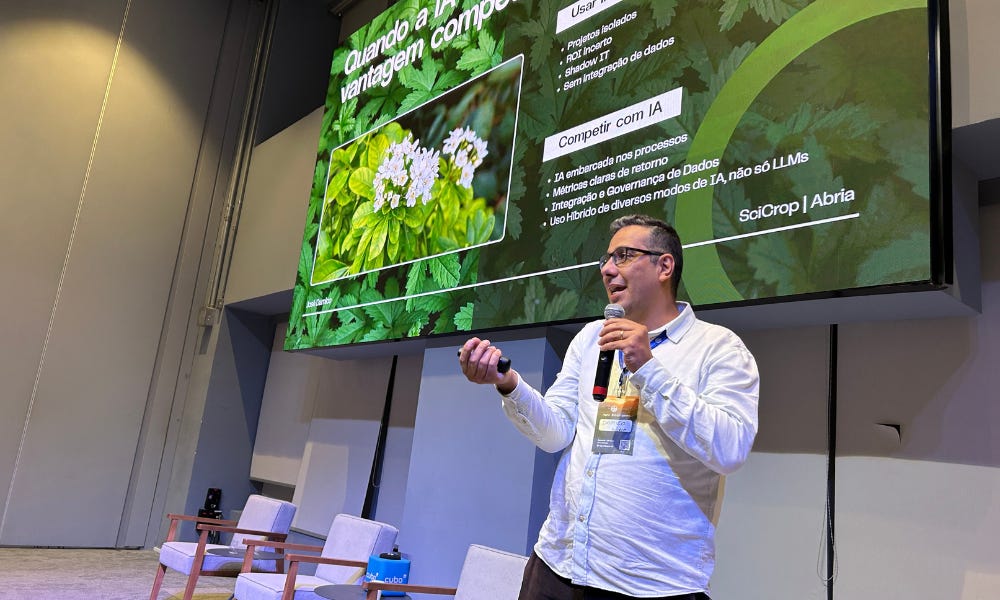
Our keynote speaker Jose Damico of SciCrop called it the “valley between pilot and scale.” For most startups, the valley of death usually appears when they try to scale. In AgTech, the first valley often comes earlier. It sits between pilot and customer adoption.
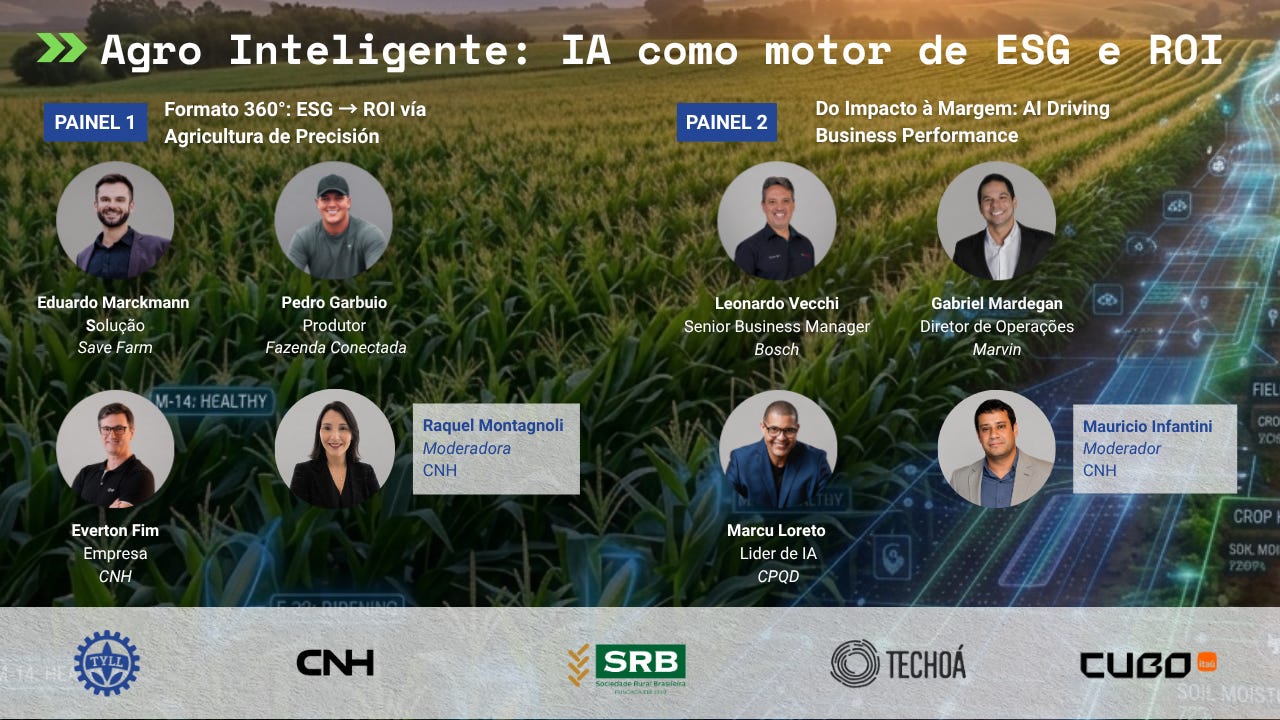
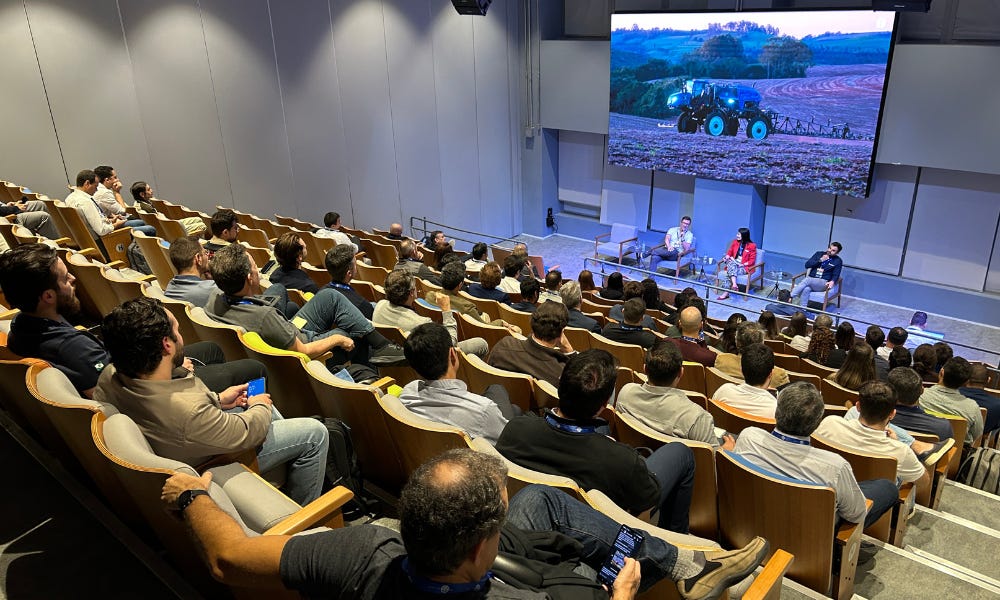
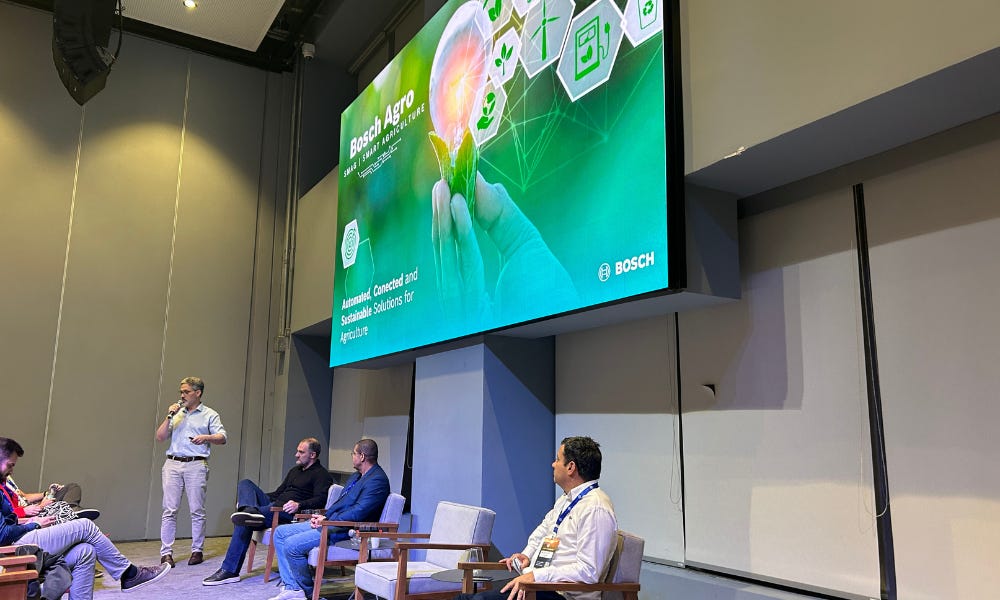
The second panel, moderated by Mauricio Infantini from CNH, kept coming back to the same issue. Corporates, startups and investors are no longer talking only about technology. They are talking about data readiness, internal ownership, ROI, integration, governance and culture. Less sparkle, more plumbing. Less demo, more delivery.
Agriculture understands preparation better than most sectors. Nobody plants because the seed brochure looks good. You check the soil, the machinery, the forecast, the financing, the team and the window. AI pilots deserve the same discipline.
No Auto-Pilot
Corporate innovation has a weakness for pilots. They are visible, contained and easy to announce. A business unit has a problem. A startup has a solution. A project is launched. Everyone can point to movement.
But AI adoption does not run on auto-pilot.
Pilots in agriculture are unusually hard because the field does not wait for the project plan. Seasonality limits how often a solution can be tested. A crop cycle does not wait for procurement. A pest outbreak does not wait for legal. A logistics bottleneck does not wait for the next steering committee. Miss the window, and the company may lose months before it can try again.
Then come the practical issues. Field teams may not buy in. Data may be messy or inaccessible. Connectivity may fail. The real operation may not behave like the neat version described in the kickoff meeting. The startup may discover that the problem is different from the one it was asked to solve.
That is why a pilot can work technically and still fail commercially. It can produce a dashboard nobody opens, a prediction that arrives too late, or an insight that does not connect to a decision. It can excite the innovation team but never reach the operational team that owns the budget, the people or the process.
The usual assumption is that the main risk is technological. Will the model work? Will the AI produce a better answer? Those questions matter, but they are rarely enough. In agribusiness, the bigger risks are often organizational and operational: who owns the result, which workflow changes, what metric justifies expansion, and who has authority to move from test to rollout.
Without those answers, even strong technology can stall. The pilot may generate activity, but activity is cheap. Adoption requires time, trust, budget, behavior change and internal alignment.
Built In, Not Bolted On
AI only matters in agribusiness when it changes a decision.
Many companies are still testing tools around the edges of the business: LLMs, dashboards, agents, image recognition, predictive models and workflow automation. Some create useful quick wins, especially when they remove manual work or speed up analysis. But too many remain disconnected from the core systems and daily decisions that actually drive the business.
The symptoms are easy to recognize: isolated projects, uncertain ROI, shadow IT and no data integration. AI becomes something to test on the side, rather than something that changes how the company operates.
That is where many pilots lose momentum. They prove that something can be analyzed, predicted or automated, but they do not prove that the result will be used. A dashboard nobody opens does not change much. A recommendation that arrives after the decision has been made is just a very smart post-mortem.
Agriculture is full of decisions where better intelligence can make a real difference: when to spray, how to price credit, which freight route to choose, or which producer needs support before a small issue becomes a larger loss. AI can help with these decisions, but only if it sits close enough to the workflow to influence action.
The better question is no longer “What AI tool should we test?” It is “Which business decision would become faster, cheaper, safer or more valuable if better intelligence were built into it?”
ROI Roots
For an AI pilot to become part of the business, it needs to prove ROI. Everything else is a nice-to-have.
That may sound obvious, yet many pilots still begin with fuzzy goals like “improve efficiency,” “generate insights,” or “support ESG.” These can be useful directions, but they rarely close a budget discussion. In agribusiness, value needs to show up in familiar terms: reais per hectare, sacks per hectare, input reduction, days saved, risk avoided, freight costs lowered, claims reduced, working capital released or field visits optimized.
This is where Damico’s three pillars of data, integration and culture become practical. Data gives the model something useful to work with, but only if it is organized, accessible and tied to the real problem. Integration matters because an AI output sitting outside the workflow usually becomes another report. Culture matters because field teams, managers and operators need to trust the recommendation enough to act on it.
That trust is especially important in agriculture, where many decisions still depend on local knowledge and experience. A model may detect a pattern, but someone still needs to believe it enough to change a route, adjust an application, approve a credit line or call a farmer before a small problem becomes a larger loss.
ROI is also a useful discipline because it forces clarity. It makes the company define what the pilot is supposed to change, who needs to use it, which data matters, and whether the result is strong enough to justify moving forward.
The more concrete the metric, the easier it is to decide whether a pilot deserves to move forward.
Pilot Prep
A better AI pilot starts before anyone chooses a startup.
The first step is to define the problem properly. What decision needs to improve? Who owns that decision? What is the cost of getting it wrong today? Too many pilots begin with broad ambition, such as “use AI for ESG” or “improve productivity,” when they need a sharper business question.
The second step is to understand the solution landscape. Many corporates know they want AI, but have little visibility on what is already available, which startups are credible, and which tools are mature enough for their context. A good pre-pilot process should help separate real solutions from impressive demos.
The third step is to design the pilot for adoption from day one. That means defining success metrics, data requirements, internal owners, user workflows and next steps before the test begins. A pilot should not end with everyone asking, “Now what?”
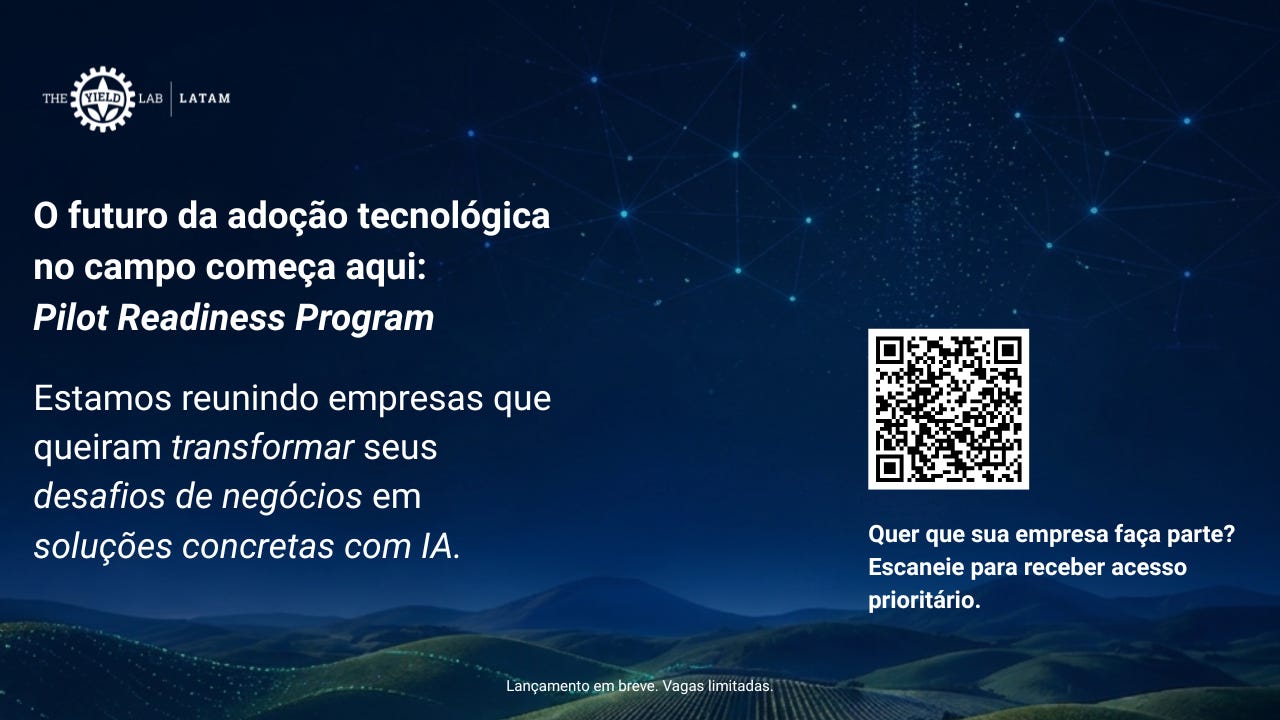
We are developing a new initiative, the Pilot Readiness Program, to help agribusiness companies prepare AI pilots before they start, with a focus on problem definition, solution curation, internal alignment and ROI targets. More on that soon. For now, the point is simple: AI in agro does not need more pilots. It needs better-prepared ones.
Thanks for reading.
KFG
Kieran Finbar Gartlan is an Irish native with over 30 years experience living and working in Brazil. He is Managing Partner at The Yield Lab Latam, a leading venture capital firm investing in Agrifood and Climate Tech startups in Latin America.