


Hi, I’m Kieran Gartlan, Managing Partner at The Yield Lab Latam, ranked second in the world last year for AgTech investments. If you’re interested in learning more about Brazil’s AgTech opportunity, feel free to reach out.
In Brazil AgTech news this week, Valeouro and Symbiomics join forces to develop gene-edited bioinputs, John Deere prepares to launch a natural-language AI agent for its connected machinery, Solinftec reshapes its leadership around an AI-first strategy, and Ecorobotix introduces plant-by-plant precision spraying in Brazil.
In Climate Tech, Google backs methane reduction and carbon removal across 200,000 hectares of Brazilian rice, corn-ethanol growth could require US$2.9 billion in new eucalyptus plantations, and proposed carbon-registry rules could restrict Brazilian credits’ access to international markets.
In Funding & M&A, Doroth raises US$4.6 million to scale molecular diagnostics, iRancho opens a US$2 million round as it moves toward rural finance, xFarm acquires Sibium to enter Brazil’s sugarcane sector, and NotCo sells its Brazilian operation while pivoting toward AI licensing.
And in Macro & Markets, Brazil prepares new regulations for bioinputs and on-farm production, a sulfur shortage forces domestic phosphate plants to cut production, and staff shortages halt ten IAC crop-breeding programs.
AgTech
Valeouro and Symbiomics Partner to Develop Gene-Edited Bioinputs
John Deere Prepares Agricultural AI Launch for Brazil
Solinftec Reshapes Leadership Around AI-First Strategy
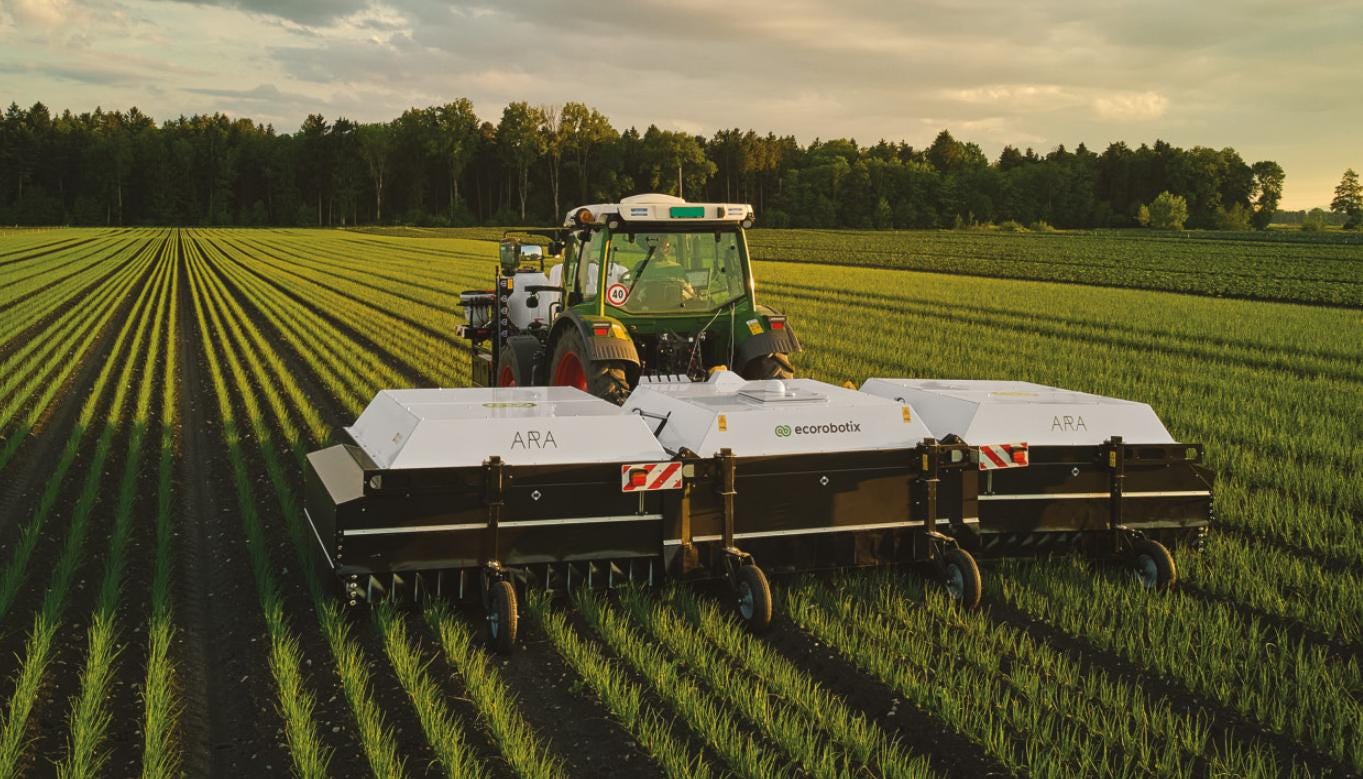
Ecorobotix Brings Plant-by-Plant Precision Spraying to Brazil
Climate Tech
Google Backs Methane Reduction Across 200,000 Hectares of Brazilian Rice
Corn-Ethanol Expansion Could Require US$2.9 Billion in New Eucalyptus
Carbon Registry Rules Could Block Brazilian Credit Exports
Funding & M&A
Doroth Raises US$4.6 Million to Take Molecular Diagnostics into the Field
iRancho Opens US$2 Million Round to Expand into Rural Finance
xFarm Acquires Sibium and Enters Brazil’s Sugarcane Sector
NotCo Sells Brazilian Operation and Pivots Toward AI Licensing
Macro & Markets
Brazil Prepares New Rules for Bioinputs and On-Farm Production
Sulfur Shortage Forces Brazilian Phosphate Plants to Cut Production
Staff Shortages Halt Ten IAC Crop-Breeding Programs
AgTech
Valeouro and Symbiomics Partner to Develop Gene-Edited Bioinputs — Valeouro Biotec has partnered with Symbiomics, to develop biological inputs using microorganism discovery, machine learning and genomic editing. Symbiomics will lead the initial research, while Valeouro provides production and commercialization capacity through a new biofactory in Cravinhos, São Paulo, receiving more than US$20 million in investment. The first joint product is expected to be a biofungicide for soy, corn, cotton and sugarcane. Symbiomics is a Yield Lab Latam portfolio company. Source: AgFeed
John Deere Prepares Agricultural AI Launch for Brazil — John Deere is testing an AI agent that will allow farmers to question their operational data using natural language. Integrated with the Operations Center, “JD” can compare fuel consumption, planting quality, spraying capacity and harvest conditions using each farm’s machinery and agronomic history. The company plans to launch the tool in Latin America by the end of 2026 and is approaching 100,000 connected machines in Brazil. Source: Revista Cultivar
Solinftec Reshapes Leadership Around AI-First Strategy — Solinftec is reorganizing its senior leadership as its founders become more directly involved in accelerating an AI-first strategy. The changes reportedly include the departures of global vice-president Denis Arroyo Alves and CTO Henrique Nomura. The company wants to integrate its Alice multi-agent platform more closely with Solix autonomous robots and connected agricultural machinery, an approach it describes as “physical AI.” Solinftec did not comment on the reported personnel changes. Source: AgFeed
Ecorobotix Brings Plant-by-Plant Precision Spraying to Brazil — Swiss AgTech Ecorobotix has appointed Horttak as its first official Brazilian distributor, initially targeting vegetable farms in Minas Gerais and Goiás. Its ARA sprayer combines 3D and RGB cameras with AI to identify individual plants and apply inputs within six-by-six-centimetre zones. Ecorobotix claims the system can reduce crop-protection volumes by as much as 95%. The first Brazilian field demonstrations are planned for the final quarter of 2026. Source: Revista Cultivar
Climate Tech
Google Backs Methane Reduction Across 200,000 Hectares of Brazilian Rice — Google has signed its largest carbon-removal agreement to date with Terradot, covering rice farms in Rio Grande do Sul. Farmers will periodically drain flooded paddies to reduce methane emissions, while crushed volcanic rock will be applied to remove atmospheric carbon permanently. Google will purchase one million tonnes of methane impact by 2030 and another million tonnes of permanent carbon removal by 2040. The model could eventually expand across Brazil’s 1.5 million hectares of rice. Source: CNN Brasil
Corn-Ethanol Expansion Could Require US$2.9 Billion in New Eucalyptus — Brazil’s corn-ethanol capacity is projected to grow from 10.9 billion litres in 2025 to 25.3 billion by 2030, creating a major demand for renewable biomass. In Mato Grosso alone, Itaú BBA estimates that another 218,000 hectares of eucalyptus could be needed. Establishing those forests would require approximately US$1.5 billion under its base assumptions and as much as US$2.9 billion if industrial and forestry efficiency is lower. Source: AgroTimes
Carbon Registry Rules Could Block Brazilian Credit Exports — Brazil’s Finance Ministry is trying to prevent credits registered for international transfer from losing recognition among foreign buyers. Current legislation requires export-bound credits to enter the national emissions-trading registry as CRVEs, potentially breaking their chain of custody with international standards such as Verra, Gold Standard and ART Trees. The government is discussing solutions with certification bodies and the international aviation regulator ICAO as it prepares the implementing rules. Source: Capital Reset

Funding & M&A
Doroth Raises US$4.6 Million to Take Molecular Diagnostics into the Field — Brazilian deeptech Doroth has secured US$4.6 million in a financing package led by biotechnology company Loccus and supported by Finep and Fapesp resources. Doroth’s portable system uses microfluidic chips to identify agricultural pathogens and resistance genes without sending samples to a laboratory. The capital will help build an automated Brazilian factory capable of producing four million chips annually, increasing production from 30 chips per day to approximately ten per minute. Source: AgFeed
iRancho Opens US$2 Million Round to Expand into Rural Finance — Cattle-management AgTech iRancho is seeking US$2 million after returning to breakeven, with the round expected to close in early 2027. The company will use the capital to expand its technology team and develop AI-enabled products. It is also preparing to launch Lisur, a farm financial-management platform covering invoices, cash flow and accounting. Longer term, iRancho intends to use operational and financial data from its customers to assess credit risk and offer financial products. Source: AgFeed
xFarm Acquires Sibium and Enters Brazil’s Sugarcane Sector — European farm-management company xFarm Technologies has acquired Ribeirão Preto-based Sibium Analytics for an undisclosed amount. Sibium provides geospatial intelligence, traceability and ESG-compliance technology used across more than eight million hectares of sugarcane. The transaction gives xFarm an immediate presence in Brazil’s sugar-and-ethanol industry and follows its 2025 acquisition of CheckPlant. Sibium’s customers will also gain access to xFarm’s sensors, weather stations and AI-based decision-support tools. Source: AgFeed
NotCo Sells Brazilian Operation and Pivots Toward AI Licensing — Chilean foodtech NotCo has sold its Brazilian operation to investment group Ferrara for an undisclosed amount, although its brands and approximately 50 local employees will remain in the country. The transaction continues NotCo’s retreat from directly managing consumer-food operations outside Chile. The former unicorn is concentrating instead on licensing Giuseppe, its AI platform for formulating food products, to global manufacturers including Nestlé, Barry Callebaut, PepsiCo, Mars and Mondelēz. Source: AgFeed
Macro & Markets
Brazil Prepares New Rules for Bioinputs and On-Farm Production — Brazil is preparing to publish regulations governing the production, registration and use of bioinputs. The draft establishes traceability and transport requirements for on-farm production while allowing simplified registration for certain products and previously assessed microbial strains. MAPA would lead oversight, although Anvisa and Ibama would retain responsibility for health and environmental risk assessments. Some industry groups fear the rules could make registering biological crop-protection products unnecessarily complex. Source: AgFeed
Sulfur Shortage Forces Brazilian Phosphate Plants to Cut Production — Mosaic has halted or reduced production across several Brazilian operations as geopolitical disruption and shipping constraints restrict the global supply of sulfur, a key raw material for phosphate fertilizers. The measures have affected facilities in Minas Gerais, Goiás, Bahia, Tocantins and Mato Grosso, triggering layoffs and temporary contract suspensions. Prolonged disruption could further reduce domestic phosphate production and increase Brazil’s dependence on imported fertilizers. Source: CNN Brasil
Staff Shortages Halt Ten IAC Crop-Breeding Programs — The Instituto Agronômico de Campinas has discontinued ten crop-breeding programs after retiring and deceased researchers were not replaced. The affected research covers rice, soybeans, cotton, wheat, oats and other crops, while another seven programs are each maintained by only one scientist. The shortage also threatens germplasm collections containing traits that could help Brazilian agriculture respond to drought, heat, pests and diseases. Source: CNN Brasil
That’s all for this week, thanks for reading,
KFG
Kieran Finbar Gartlan is an Irish native with over 30 years of experience living and working in Brazil. He is Managing Partner at The Yield Lab Latam, a leading venture capital firm investing in Agrifood and Climate Tech startups across Latin America.